Sunday, March 29, 2015

(Bill) So THAT'S what a scrum feels like!

Yesterday, I ticked off one of the boxes of things that I hoped to do before leaving Malawi.  As a former British colony, Malawi has inherited its rugby tradition and culture.  Though it is not a sport of the masses on the level of football (sorry, soccer), it has a strong following that is apparently growing.  I have been getting acquainted with the sport by playing "touch" rugby Thursday evenings at the Blantyre Sports Club.  Liam's teacher, Mr. Staines, and the school's PE teacher, Mr. Ferguson, invited me to come along last fall and I've been slowly trying to improve my game.  Most of the guys that show up have been playing most of their lives in various places of the British commonwealth and they move naturally and can huck the ball around with ease and accuracy.  I felt that playing an actual full-contact rugby match would be out of the question and that these experienced players wouldn't want a rookie American on their championship squad.  Well, they needed bodies on Saturday and felt that I was finally ready for the big time. 
 This, of course, set my cautious son (Liam) into a week-long fit of stress certain that I would be maimed and quite possibly killed.  I guess I had some fears along those lines as well.  There are some big dudes that play rugby and Mr. Ferguson had recently dislocated his ankle as a fresh reminder of the sports' violence.  The guys placed me in the second line of the scrum.  I won't get into the rules of the sport, but my focus was to push as hard as I could into the right buttocks of a 270 pound (or so) Malawian behemoth nicknamed "The Beast".  Very quickly you get acquainted with the players on your team as you grab and hold and lift and pile on top of each other.  That is me #22 (above) pushing behind The Beast.  Liam's teacher, Mr. Staines, is #9 and he plays the equivalent of a quarterback once the ball pops out of the scrum.
At the end of the day, we lost the match to our division rival comprised of teachers and students from Saint Andrew's High School.  This was a championship game for the 15 aside season and the BSC team was down players, thus my playing opportunity.  Seeing those high school boys run around with so much speed and power made me recall my very distant youth.  There was a ton of testosterone and lots of big hits.  Plenty of exhortation (I'll just keep it at that).    One guy was carted off and there were several injury stops.  Fortunately, I only came away with a black eye and sore everything else.  The 7 aside season starts soon and I'm hoping to get into some more action.  Sorry, Liam.  (=

We had a big laugh as a family reading this peanut packaging.  There must have be something lost in the translation.  If someone can figure it out, please let us know!

Wednesday, March 25, 2015

(Bill) The boys look great in makeup

Don't be scared.  This is just Micah in traditional vampire makeup for the local St. Paddy's Day celebration.  Last Saturday, we joined in the fun with much of the Blantyre expat community  to celebrate all things Irish (see: vampire face painting).  There were three legged races, potato sack races, potato on spoon races, tug-o-war, traditional Irish bouncy castles, wheel barrow races, lots of races.  We had a great time and we were introduced to an Irish sport called hurling.  No, this does not start with chugging 6 pints of Guinness.  To play, you wield a long handled, flat-faced club and just whack the snot out of a leather ball to your teammate.  You do this to advance the ball and score points.  Later in the afternoon, there was a hurling competition for distance.  I'm pretty sure I won it, but people got distracted and lost interest (see: Guinness).

Below is our favorite crocodile taking a bow in his school play, Alice in Wonderland.  Opening night was last night and we were so impressed with the quality of performance.  Wonderful costumes, makeup, sets, and special effects.  The acting was wonderful as well.  Liam was disappointed to only have one line (nailed it!).  He sounded interested in getting more involved with drama productions in the future.  We hope he means drama productions at school.
My last blog post promised that Micah would get his sporting glory at the school Infant Swim Gala (for Kindergartners through second grade).  This is a country where swim suits are called swim costumes and swim meets are galas.  So regal!  Look at that steely stare as Micah sights the finish line across the width of the pool.  Seconds later in the water, he would take a left turn and completely take out two of his neighbors.  Whatever it takes, Micah!


There are several people at home (okay, just Mom) who are keeping track of my traffic ticket tally, or TTT.  I'm happy to report, Mom, that it has been three months since my last moving violation on Christmas day (for the record, going almost 2 miles over the speed limit).  Now that I have the proper paperwork and stickers for the car, I can't even seem to get pulled over recently.  Elizabeth theorizes that I must just have a different look about me as I drive--a certain confidence or swagger that acts a mosquito repellent.

Thursday, March 19, 2015

(Bill) Sports in Malawi

There are many opportunities to be active in Malawi.  Liam and Micah have had plenty of pool time through their classes at school, but Liam decided to get more involved and joined the swim team.  He is a good little swimmer, especially at breaststroke.  Two weeks ago, he had the opportunity to swim in the National Meet held here in Blantyre.  Only here in Malawi where the swim community is relatively small would Liam get such an opportunity.  
 Liam has also been able to play sports that aren't played as much in the U.S.  Here is Liam playing in a touch rugby match against a rival school.  He even scored his first "try"!  In the fall, he got to compete in cricket and his excellent arm and eye/hand coordination came in handy.
 Of course nothing beats the most accessible sport of playing baseball in the backyard.  Micah is amazing with a bat!  Need to get him on a baseball team when we get home.  Tomorrow morning, Micah gets some sports glory in the "Infant's Swim Gala" at school.  He is eager to show off his ability to do the butterfly stoke.  He's pretty good at it too!
 This is our triathlon team "Young At Heart".  Elizabeth, our friend John McGrath and me signed up to compete in the "young adults" division in a local team triathlon competition.  I was the swimmer, John on the bike and Elizabeth ran.  Well, we won!  Oddly, the sponsor for this event is the local sugar producer and so we each took home a bag of sugar and a few other cool prizes.
 Elizabeth also competed in the over 40 "master's division".  Her team won as well.  Here is her teammate, Tim, handing off.
 Hello from all of us!

Tuesday, March 17, 2015

(Bill) Elliott

Most people reading this blog wouldn’t know Elliott Walters, but I want to tell you a bit about him.  Elliott died last week and it has been very sad for our family.  He was a remarkable man who will continue to live in our memory. 

Elliott came into our family eight years ago when he began dating Elizabeth’s mom, Christine.  We knew a few things fairly quickly about this man.  We knew that he had had a wonderful first marriage and had lovingly cared for his wife for many years as she suffered Alzheimer’s at the end of her life.  Together, they created a wonderful, warm family with four kids and many grandkids, most of them still in the Seattle area.  Elliott had served in the Korean War through the Marines and was a retired insurance man.  Though an older man at 79 when he met Christine, we could tell that Elliott had plenty of life and love to give.  

The more we got to know him, the more we realized that Elliott was a man of many irrepressible passions.  One standout interest was with trains.  Our eyes were like saucers stepping into the train room of his house for the first time.   Not many people would modify their home to accommodate train tracks running in and out of the walls, but Elliott did!  He had put together a room with mountains, sky, lakes, and towns crisscrossed by tracks.  And all to perfect scale!  With great pride, he showed us the replica trains that he had collected and could send them on their way with a central controller with coordinated Johnny Cash music and puffs of smoke from the stacks.  My sense was that his greatest pleasure was sharing his love of trains with many kids that were invited to take it all in. 

Elliott’s passion wasn’t solely with trains.  Flags anyone?  Elliott had a large flagpole in the front of his house and he faithfully ran different flags up and down every day to mark special days on the calendar.  I’m not sure how many flags he owned and stored by hanging on pegs in his front hallway, but the number is impressive.  

How about squash or tennis?  Elliott was quite the athlete winning numerous squash trophies as a younger man.  He kept up his racket sport passion faithfully playing tennis several times a week and making many friends along the way.  Not many octogenarians have asked me if I wanted to hit around.  Very impressive.

Elliott was very active in his church.  He was particularly excited when “Nigerian Sunday” rolled around and the Nigerian congregants that shared the building would combine services with his.  He had a genuine faith in God and would insist on giving thanks for meals with the traditional Episcopalian grace:  “Lord, for what we are about to receive, make us truly grateful”.   And he was indeed truly grateful for all he had. 

He loved politics and reading books on history.  I didn’t always agree with Elliott in discussing various topics, but I could count on him having an opinion that, again, he was passionate about.  He loved to host parties and he was delighted to have friends and family around him.  He and Christine did an amazing job with various gatherings throughout the year:  birthdays, Christmas, Easter, Thanksgiving, or just because.  Only Elliott could be seized with the idea to have an entire pig roasted and served up on their back patio.  

The greatest passion in Elliott’s life was his family.  It was love at first meeting for Elliott and Christine at the opera guild small group.  When you’re 79 years old, you don’t mess around with a long courtship and he made plain that he was looking to marry Christine on the second or third date.  We’re so glad they did go on to get married.  They shared a wonderful marriage and friendship and it seems that they were partnered for longer than the eight years they knew each other. 

We could see the quality and depth of his relationships with his biological family, but we were so blessed that he invested deeply in our family as well.  He absolutely LOVED our boys.  At first, we maintained a formal title of “Mr. Elliott”, but this title didn’t seem appropriate, as he loved Liam and Micah as his own grandsons.  “Grandpa” and Christine would regularly take the boys on adventures as they explored La Conner (the site of their once-monthly dog grooming sessions) and everywhere in between.   Over meals, Elliott demonstrated his passion for the boys as he would pepper them with questions about their lives.  He genuinely cared about what they had to say and would shush any adult who tried to speak on their behalf!  Not many 6 or 10 year olds have an adult in their lives that really wants to know what they think about something.  He would try to get to the boys’ sports events and school plays.  Not many men his age could be as playful and loving as he was with such young children. 

The same interest he took in the boys is the same interest he took in Elizabeth and me.  When I shared my excitement in looking at birds here in Malawi, Elliott immediately bought and sent a book on African bird watching.  He regularly bought us books that he thought might be interesting to read or would cut out articles to share.  He was generous and kind.  He was able to affirm me and encourage me in ways that are unique from an older man to a younger man.  He showed me so much about the kind of life I want to live, not just when I get to be 80, but now! 

Thank you, Elliott.  You lived an amazing life.  You loved and served well.  You have your reward, but we will all miss you.


Sunday, March 1, 2015

We can do it... and we need more of us.

March 1st 2015

My role here has developed many tentacles.  It seems that opportunities to teach or assist with clinical care pop up around me often.    Many of these opportunities pass me by because of lack of time or expertise, but more often than I expected I have a sense that I would be relatively well equipped to help.  Though I have to be careful that I don’t jump in to too many things, having the realization that a person like me could fill this role gives me a little boost of family medicine pride.  It feels like the fact that I could do it is evidence for my side of the unspoken debate: On one side of the debate is the argument that Family Medicine is not needed in this country, it is functioning well enough with the specialties it has.  And more energy should be put into higher-level specialty care rather than broadly trained primary care providers.  On the other side of the debate is the argument that Malawi is building a healthcare system without a solid foundation.  There are silos of health care delivery that are not integrated, and vertical programs that forget the whole person and the context within which that person is experiencing illness.  A family physician at the foundation of the health care system is imperative to provide comprehensive care where for a wide range of interwoven conditions close to where patients live.  
So when a family physician is well suited to respond to these teaching or clinical needs, it makes me feel like I can showcase family medicine in a practical way.  Thus, this is proof that more family doctors are needed in this country.

Last week the department of Family Medicine was asked to teach a geriatric conference to clinicians and nurses that are working to set up a brand new “geriatric center for excellence” just outside of the city.  This clinic and hospital is situated in a rural area. A grant supported the building of this hospital out of the recognition that geriatric care is lacking in Malawi. This will be the first hospital dedicated to geriatric care in the country. Martha and I visited this site a few months ago. It has an impressive structure in place with a new ward being built, a beautiful chart filing system, modern furniture and a fully stoked pharmacy. It appears to be a very impressive start.  The program manager gave us a tour of this facility and told us of the plans to make a “geriatric center of excellence” with a lab, operating room and ICU.  When it was time for questions I wanted to know about community outreach, multidisciplinary care, social services and palliative care.  The response was mostly in facial expressions which I understood to be mostly brushing me aside with a hint of curiosity.

At the end of the tour Martha and I were asked to help them with strategic planning and also with teaching.  The clinicians and nurses hired to staff this hospital felt unprepared to take care of the elderly;  geriatric care this is not a core part of medical and nursing training in this country.  For us (on the college of medicine side), the longer-term vision is that this hospital could serve as the geriatric training site for the Malawian Family Medicine Residents in their third year.  To begin this symbiotic partnership, we decided that we would start with a 3-day course on geriatric care followed by once a month clinical teaching at their site.   

Personally, I am fine with geriatrics. I had amazing teachers in residency who continue to teach me as an attending (thank you Carroll Haymon, Carla Ainsworth and Sarah Babineau!)  Geriatrics continues to be one of the strengths of our program at Swedish.  The faculty are strong, the experiences that residents get are rich and geriatric patients receive excellent care from our residency. I am thankful to be amidst that at Swedish. But I would not say that Geriatrics is a passion of mine.  I am glad that I get to think about geriatric care in the midst of everything else.

But teaching this course was one of the most deeply satisfying teaching that I have done in a long time.  The course included the topics that you would expect: dementia, medication management in the elderly, vision and hearing loss, incontinence, palliative care etc.   These medical conditions were largely new and our students were interested, engaged and taking notes. But what was most satisfying was to introduce what I understand to be basic concepts for the first time: goals of care, minimizing harm, considering the risks of polypharmacy (prescribing more than 5 drugs at the same time), and family meetings.  These clinicians are taking care of the elderly and this was—for some of them—the first time that they had thought that providing medical care is more than choosing the right drug or doing the right procedure. Seeing the mental gears moving as they consider for perhaps the first time how comfort care can be a priority over curative care was a profound experience.  I understand why these providers have not learned these concepts before.   A very low resourced setting like Malawi needs to focus on the health problems that matter most.  Curative care is what clinicians are nurses are taught because it matters… children under 5 years die of curable causes everyday, pregnant women die during uncomplicated deliveries, people of all ages die from infectious diseases for which there is good treatment. So this is appropriately where the emphasis is.  But when you are talking about a 90 yo patient with end stage dementia and urinary incontinence, the most important issue is not what medication to use.  We also discussed that having a fancy operating room is not as important than having an effective community orientated primary care system where health workers can interact with the community and bring vulnerable elderly into the clinic or the hospital when they are ill.  More than a laboratory with expensive lab tests, it is important to educate families and caregivers about the conditions of their loved ones so they can act as extensions of the health care system. 

It feels good that in 2 ½ years our Malawian Family Medicine residents will rotate in a geriatric hospital that is truly is a “geriatric center of excellence.”  It feels good that I had some role to play in challenging these clinicians to consider how treating geriatric patients is unique.  And it feels good that some elderly patients will receive some holistic care as a result of this conference.  Family doctors can teach and practice these principles.  We need more of them in this country!  I was a philosophy major in college so I am allowed to have my own private debates AND win them. 


Wednesday, February 11, 2015

(Bill) That loud sucking sound you hear?

That loud sucking sound you heard?  That’s was my soul being Hoovered from my body as I attempted to get the proper working paperwork for our car, Black Mamba.  I can say, today, that I now have in my hot little hands the requisite forms and stickers to show police (or, “mosquitoes”, my pet name) at the inevitable roadside stops.  But, yes, it cost me my soul. 

I’ve already blogged about the process of purchasing a vehicle and the exquisite pain that this inflicted way back in September.  But things were not quite tied up at that point, as the title transfer was not official.  I was told that because of “Cashgate”, a government corruption scandal (surprise, surprise), that paperwork would now have to be routed through Lilongwe and that this would take a “few extra weeks”. 
All this in an effort to cut down on corruption and to show the world’s donor countries that Malawi could be trusted with proper governmental administration and with future donor support (to the tune of 60% Malawian GDP). 

Well, five months later, after 4 separate trips to the Road Traffic Directorate (RTD), the title had not arrived.  It had not arrived not because a quick computer check revealed this to be true, but only after thumbing through stacks of ledger books.  And more ledger books.   At the end of each fruitless search, the rather bored and slightly annoyed man “helping” me said that perhaps I should come back next month. 

This “maybe next month” approach became a problem as soon as the “Certificate of Fitness” expired at the end of January.  This dubious sticker on my windshield informs the mosquitoes that my car is the definition of “fit”.   In order to have a new C.O.F., I need a car title in my name.  Last September, I thought a five month window of time would be more than enough time to get sorted and I wouldn’t be up against a tight timeframe to have everything kosher for the cops.  Nope! 

So, with the C.O.F. sticker on my windshield now expired and traffic stops a near weekly occurrence, I was stressing out and choosing roads where mosquito stops would be less likely.  Liam, our conscientious, rule-following son, who has suffered through my three previous traffic-ticketing encounters, was beyond stressed and refusing to be driven in Black Mamba.

                                                Black Mamba with new hood ornament.

                                      The all-important C.O.F. sticker.  The cost?  Your soul.

Last Thursday, I went to the RTD and looked one more time through the ledger books.  Nada.  I asked my “helper” if there was any way possible to get the title sooner than later as my C.O.F. was now expired.  This is the same guy who has consistently been telling me that the delays were attributable to the fact that judges have been on strike in demand of pay raises.  But for 45,000 Kwacha (about $100), I could have my title in by Monday.   Miracle of miracles!

After some self-righteous comments from me intended to shame and cajole this man into action (no effect), I decided to pay the bribe so that we wouldn’t get fined for the expired C.O.F. and so that Liam would ride in the car with me again without triggering PTS.  It was a deal with the devil.  I left, stewing, to go the ATM and withdraw the money and I was instructed to wait outside the gates and my “helper” would come out to collect, not unlike some drug deal on the street.  I felt so dirty and angry as I counted out the money for this guy.  He tried to make the mood lighter by complimenting me on how nice my car is.  Really?  Black Mamba?  Get out of my face, dude. 

I’m still struggling with guilt that I have only contributed to this corrupt system.  It makes me so angry I want to start picketing the RTD offices and write letters to the newspapers.  And kicking stuff.  It’s hard for me not to get down on the whole country and make massive, inappropriate generalizations. 

And that’s not even the end of the story!  I will spare you most of the details, but after one more failed trip to the RTD (on Monday I went to collect the promised title and after a 1.5 hour wait, I was told to come Wednesday), I showed up Wednesday and FINALLY collected the title.  This enabled me to begin a 4 hour process standing in 5 separate lines, getting lots of different papers stamped, suffering a ridiculous inspection from an A-1 a**hole (at least no bribes were solicited!) and several more interactions with bored/annoyed bureaucrats suffering in this impenetrable system.  When it was all done, magical C.O.F. sticker in place on the windshield, I felt like a Harry Potter dementor had just got done with me.   My soul and joy vaporized.  I’m the little kid blubbing after a dentist visit, “Mommy, please don’t send me back there ever again!” 


Pray for me.  I feel terrible about myself and terrible about Malawi in this whole process.  And when you pray, say a little prayer of thanks for the DMV at home that processes license renewals in, maybe, half an hour?  Or for the processing of purchasing a vehicle back home that now seems so easy to me that I would be happy to do it for you when we get back to the States.  Better than therapy.  
 A happier moment as a family.  How many pictures can Micah ruin?  My Mom says I did the same as a kid.  Don't believe her for a second!

Tuesday, February 10, 2015

“That health center is difficult”

February 7th 2015

This is a common exchange during a chat with a person I am meeting. 
 “…You are a doctor? You are here working at Queens?”  (The large central hospital in town.)
“No I am working at Ndirande Health Center.” 
“Oh…”  long pause. “How is it working there… or why are you working there?” 

Why would a doctor come to Malawi and not work at Queens?  It is not common for doctors to work outside the central hospitals.

If a doctor is going to work outside the central hospital why would she be working at Ndirande? Ndirande Health center is in the middle of a poor community that has a reputation for being rough.

Why would a doctor come to work in a place that is so under-resourced?   

Ndirande Health center
The road just outside the health center
The market adjacent to the health center
Let me insert some context.  Malawi has a population of 16.3 million people.  Patients first contact the health system in the health centers or district hospitals which are staffed by clinical officers (similar to physician assistants), nurses and medical assistants.  These clinicians are well trained to see the most common conditions and to offer treatment usually based on well-designed national protocols.  At many busy health centers one clinician will see up to 150 patients per day.  Their job is to treat the patient and / or send them to see a doctor for a higher level of care.  If a patient needs to see a doctor, she will be referred to one of three central hospitals in the country because, except for missionary and other visiting doctors, there are no physicians posted to work outside of the Central hospitals. 


To the question, I explain that Family Medicine is just starting in Malawi.  The hope of this new specialty is to provide high quality primary and secondary care close to patient’s communities and to offload the overcrowded central hospitals.  Family Medicine will be training physicians outside the central hospitals.  The hope is that Ndirande will become a facility that can function to provide quality care and become a training site for family medicine in the future. 

Then I get a satisfied nod of understanding.  Everyone with whom I have spoken about this get the concept instantly. Philosophically it is not a hard sell.  But then come the practical concerns which turns into an effort to show me sympathy.

“That health center is difficult… !“ long pause.  “Do you really think you can accomplish something there?”

The first time I heard this, I did not make much of it.  But now that I have heard this many times I am beginning to understand what is going on in the background of this discourse.  Health centers have a reputation of being ineffective.  There are negative assumptions made about the skill level and work ethic of the staff.  When it comes to prestige, there is none.  The conditions are vandalized, grimy and debilitated.  A health center is a structure, there are people employed there, it is a place for patients to go when they are sick.  But I think most people thing it is façade; medical care is not actually delivered there in any meaningful way.  Ndirande Health Center is supposed to be the medical care for a population of 250,000 people (which is more than a third of the population of Seattle.)  There is a certain level of acceptance that this township of quarter of a million people is sealed in this predicament.

our short stay ward...in need of some improvements

 
If you spend a few hours observing what happens at this health center, you may come to the same conclusions.  You may feel hopeless or cynical.  Patients will wait an entire day to have a 2-minute consultation with a clinician. They will be prescribed a medication that may or may not be the right medication for their illness. The patient will go to the pharmacy, which may or many not have the medication in stock.   A patient will come in labor.  They may or may not have a bed, electricity to provide light for the delivery or even water to clean between patients.   If you come for the morning meeting you will see tired clinicians dreading to start the day and if you come at 3:30 there will be fewer than half of the providers still working.
If you spend a few months observing what happens at this health center, you will likely come to the same conclusions that I have come to.  Staff show up to work, they see a seemingly endless line of sick patients. They are unable to use the knowledge they have to properly evaluate because they do not have time.  They are unable to use the skills they have been taught because they often do not have access to supplies.  And they often cannot offer treatment because of lack of the correct medications on hand. 
They do this all day after day with very little acknowledgement or appreciation.  They are often paid very late or not at all.  There is little chance for professional development or collegial interaction.  And on top of all this, they know the sentiment in the medical community: that the health centers are little more than a façade of medical care. 

For the past few months I have worked with the staff at Ndirande. Their experience and medical wisdom is exceptionally good. Their eagerness to learn is exuberant.  We have started with small activities that are meant to acknowledge and appreciate the work that is being done day in and day out.  

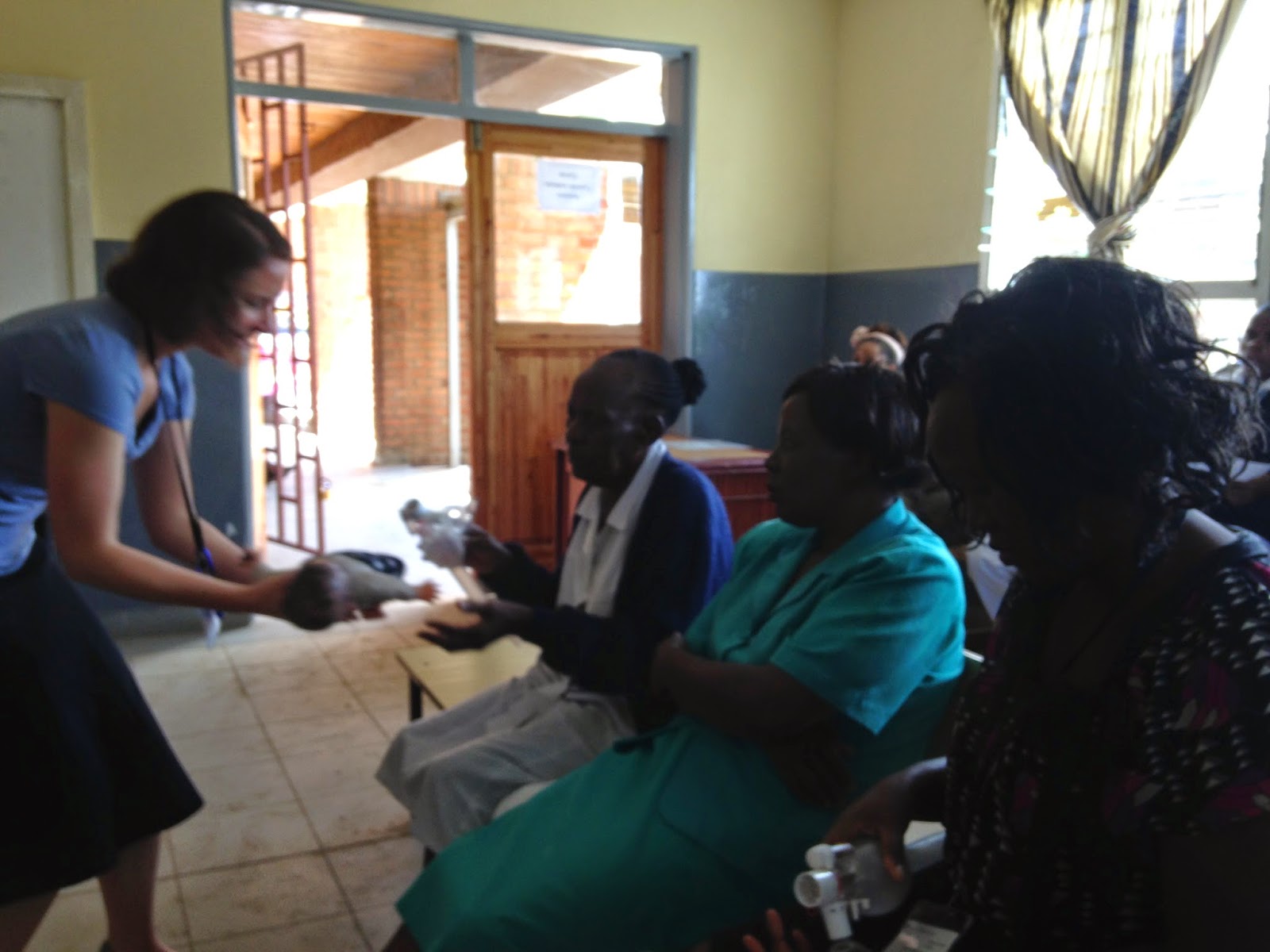
Emily (one of the residents doing wednesday teaching on neonatal resuscitation)
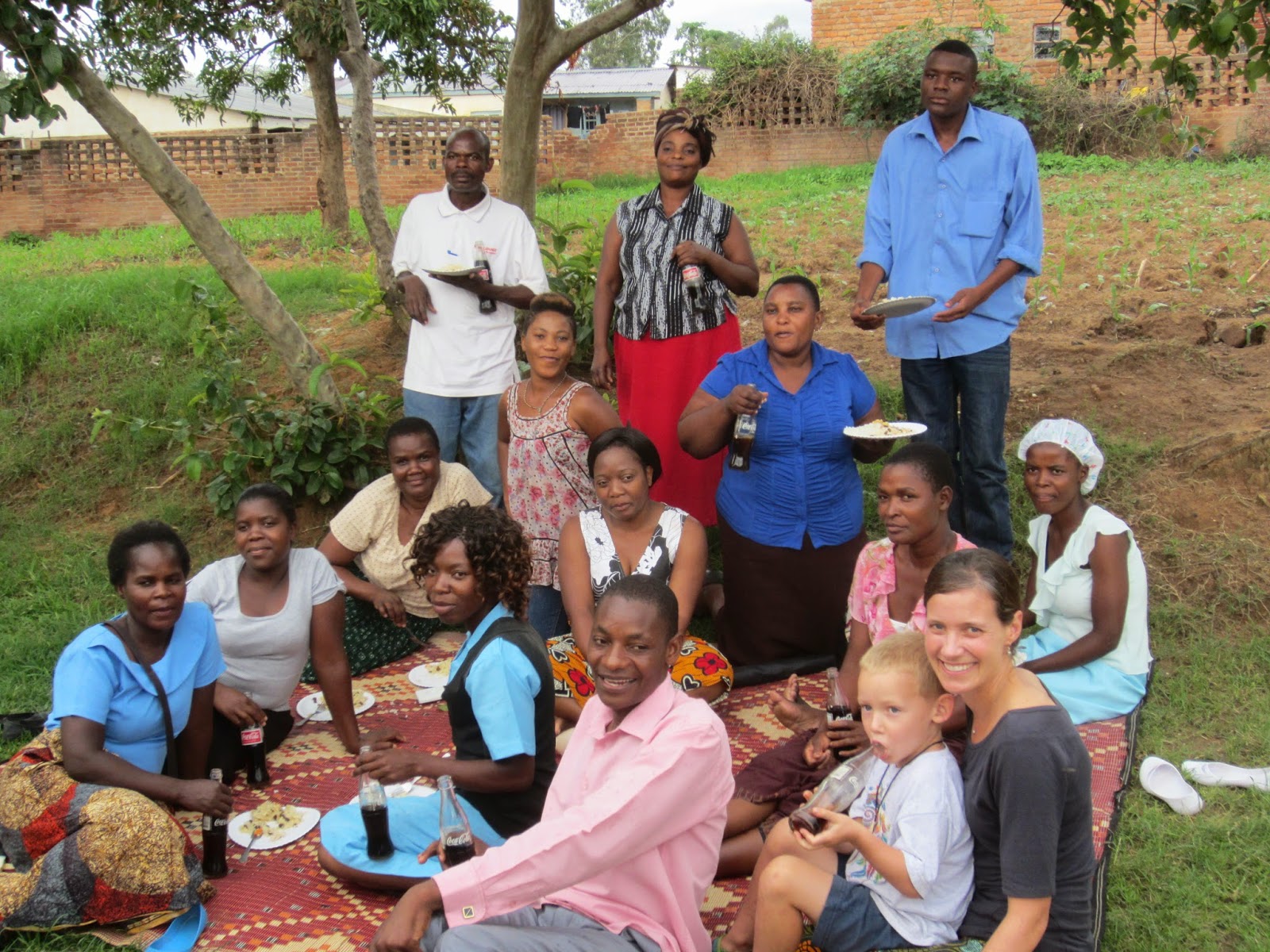
We have morning meetings and weekly teaching.  We have had a party to try to get to know each other a bit outside of work and we try to enjoy an Nsima lunch together.  


We consult each other, ask for help and correct each other. We acknowledge each other’s strengths and try to fill in the gaps when they exist.  I believe there is a desire to work as a team to build something that works well.  It seems that people are changing.  maybe it is just my perspective. But I feel that people are enjoying their work more, that they feel some reason to come to work and smile and some reason to stay a little later to see patients.  I have seen people genuinely happy with a patient who gets better because of the care we have delivered and people upset because the system will not let us do a better job. 
Teaching a medical assistant some ultrasound basics


hanging protocols on the wall to have easier access to information needed consistently 


These changes do not cost money.  But it is my hope that a culture of affirmation, acknowledgement, teamwork and collaboration will lead to better care for the 250,000 patients who depend on Ndirande for care.

Though I though we would have had Malawian medical students by this time in the year at Ndirande a few months ago, I understand now that this is providential.  What we are building now is a functional primary health care team that involves providers of different levels working together to try to provide integrated care across the health center. We are building this health center with the principles of family medicine.  It is into this culture that medical students hopefully will see family medicine in action.

It has been a while since I have blogged.  I think I have felt a little discouraged at times with regard to the slow progress and the fact that our time is already ½ way gone.  I have lamented that my role here, to help build family medicine in Malawi is not a one-year job it is a 3-5 year job and maybe I am a fool to think that I can really do anything.  But I am beginning to truly accept that lasting change happens slowly and will span many people who come with the same job description.   Acknowledging the small steps that are part of something bigger is very helpful to me….I should really blog more often.